Marketing Attribution is Broken. Here’s How We Fix It.
1. The Hook
I was sitting in the glass-walled conference room at Datagrad HQ, staring at a very angry CEO on the big screen. The client was Ujvi Candles, a D2C luxury brand that had just blown their quarterly budget on a "viral" TikTok campaign.
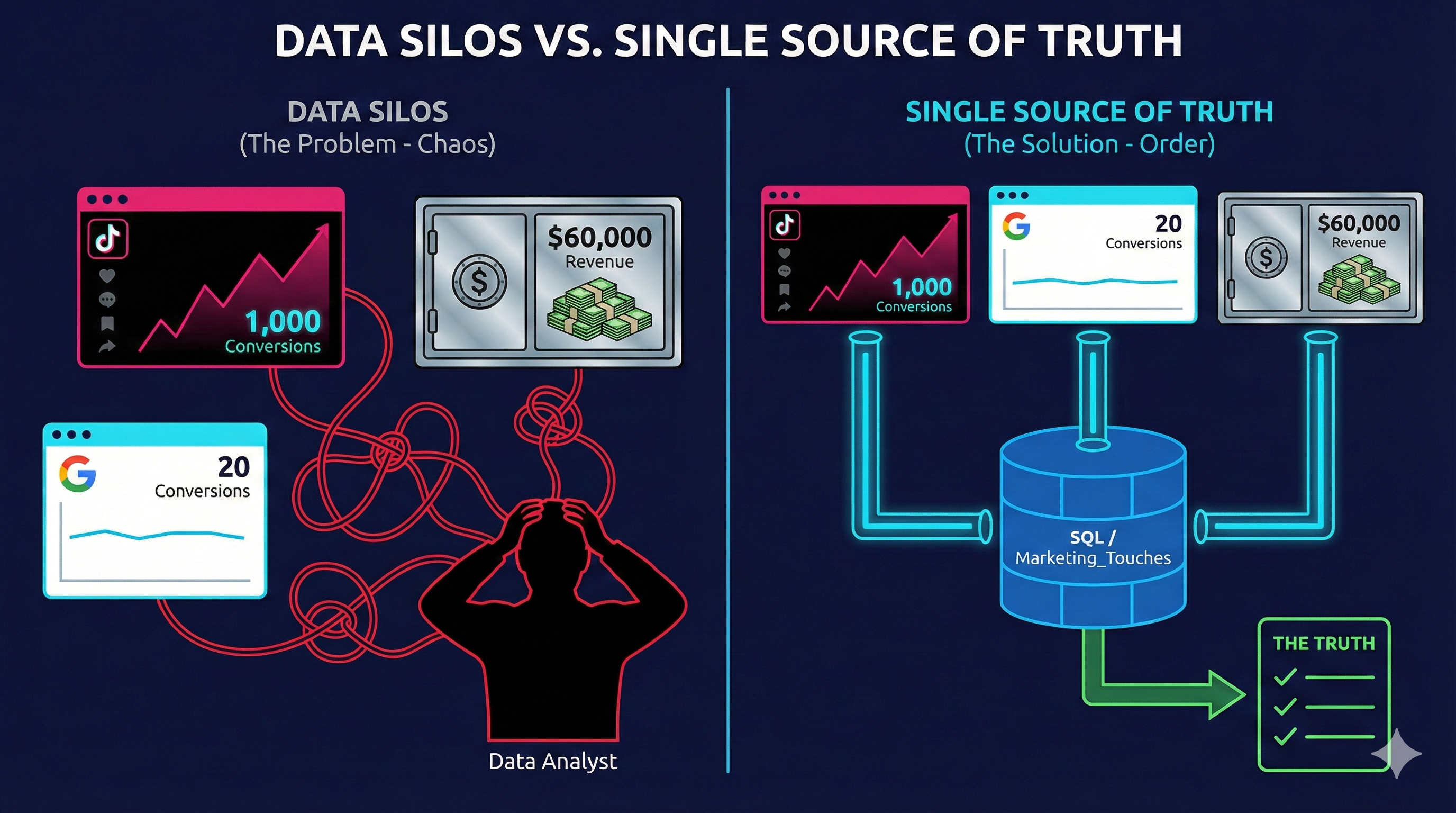
"My ads manager swears TikTok drove 1,000 orders last month," the CEO said, slamming his hand on the table (virtually). "But I’m looking at Google Analytics right now, and it says TikTok drove twenty orders. Twenty! Who is lying to me?"
"Neither of them," I said, leaning into the microphone. "They’re just speaking different languages."
This is the classic Ujvi Paradox. The ad platform (TikTok) wants to claim credit for everything it saw. The analytics platform (GA4) wants to give credit to the very last thing that happened before the sale.
The CEO sighed. "So how do I know if my $50,000 spend actually worked?"
"You don't," I replied. "Not until we stop relying on their dashboards and build our own Truth."
Please ensure the file is named exactly:
Blog 1.1.png
2. The "Aha!" Moment
Here is what I tell my clients: Stop looking at the Scoreboard, start watching the Game.
Most marketers look at "Aggregate Reports." Imagine watching a basketball game, but you only see the final score: Lakers 105, Celtics 100. You know who won, but you have no idea who passed the ball, who got the rebound, or who set the screen.
Google Analytics is the Scoreboard. It tells you "Direct Traffic scored 100 points."
To fix attribution, we need Event-Level Logging. We need the "Game Tape." We need to track every single time a user touched the ball (clicked an ad, opened an email) before they scored (bought a candle).
Once we have the raw plays, we can decide who deserves the MVP trophy. But first, we need to build the stadium.
3. The Solution (The Code)
Here is the SQL architecture I built for Ujvi today. We aren't doing anything fancy yet—no machine learning, no Markov chains. We are just creating a clean, unified container for every marketing touchpoint.
SQL Schema/* Author: Datagrad Lead Architect
Client: Ujvi Candles
Goal: Consolidate cross-channel data into a single linear path
*/
CREATE TABLE marketing_touches (
TRANS_ID VARCHAR(50), -- The unique User ID (Cookie or Login)
ORDER_ID VARCHAR(50), -- The Transaction ID (The Conversion)
TOUCH_SEQUENCE INT, -- CRITICAL: The order of events (1, 2, 3...)
TOUCH_TIME TIMESTAMP, -- When it happened
CHANNEL VARCHAR(50), -- Source (TikTok, SEO, Direct, Email)
ORDER_VALUE DECIMAL(10,2) -- How much the conversion was worth
);Why this schema works:
- TRANS_ID: This allows us to stitch a user's history across days or weeks.
- TOUCH_SEQUENCE: This is the magic column. Most exports don't give you this. We calculate it by sorting TOUCH_TIME for every user. It transforms a "bag of clicks" into a "story."
- ORDER_ID: We associate every touch with the final conversion it belongs to.
4. The Reality Check
"Okay," the Ujvi CEO said. "That's just a database table. How does that solve my missing $50k?"
"Let's look at a real example from your logs," I said. "I pulled Order #11200823."
First, here is how we populate the data for this specific user:
SQL InsertINSERT INTO marketing_touches VALUES
('2241677', '11200823', 1, '2026-02-16 21:11:16', 'PPC/SEM', 125.00),
('2241677', '11200823', 2, '2026-02-16 22:27:08', 'SEO', 125.00),
('2241677', '11200823', 3, '2026-02-19 21:40:31', 'Direct', 125.00),
('2241677', '11200823', 4, '2026-02-28 18:12:37', 'Direct', 125.00),
('2241677', '11200823', 5, '2026-02-28 22:24:15', 'Direct', 125.00);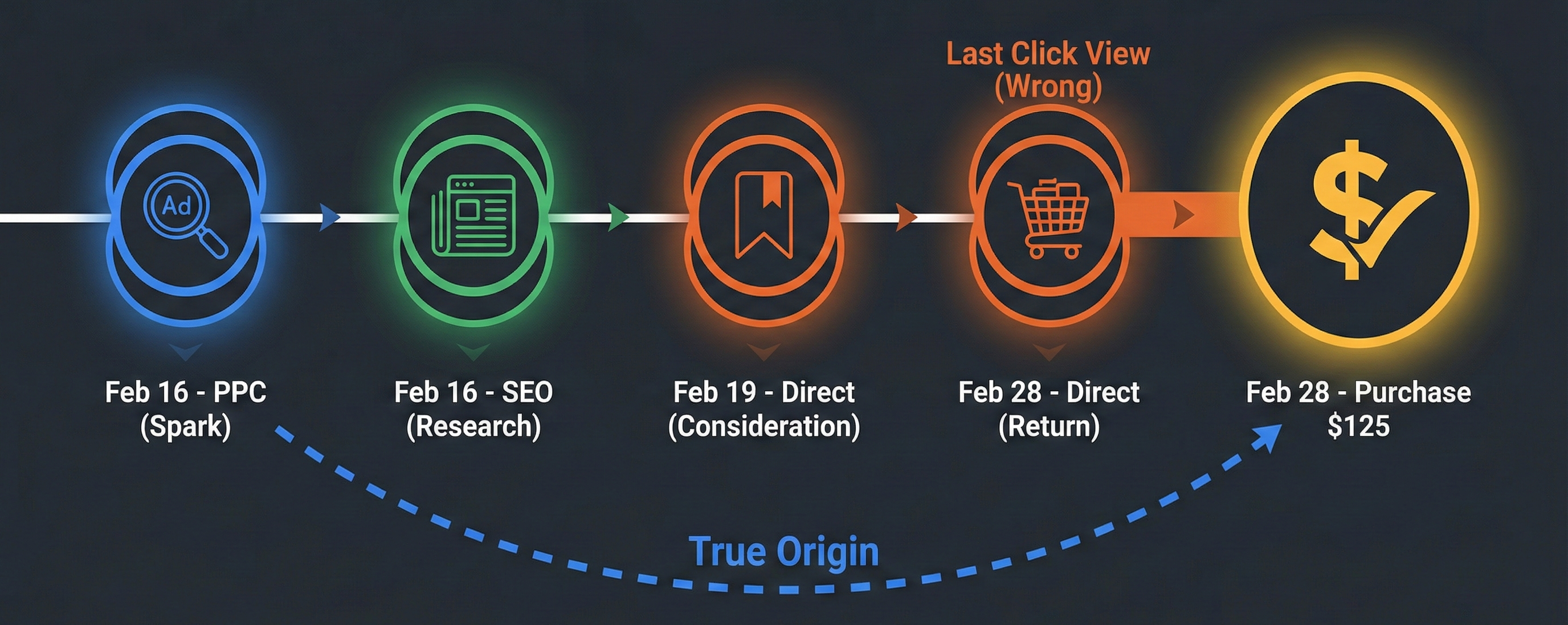
Please ensure the file is named exactly:
blog 1.2.png
The Journey of User 2241677 till Purchase (Order #11200823)
The Implication:
If you look at Google Analytics (Last Click), Direct gets 100% of the credit ($125). PPC/SEM gets $0.
This is why the CEO was firing his PPC agency. He thought they were useless. But looking at the SQL data, we see that PPC was the Spark. Without that first paid click on Feb 16th, the user never would have known Ujvi Candles existed. They never would have Googled it (SEO), and they certainly wouldn't have come back directly.
By moving to this SQL structure, we proved that the "useless" ad spend was actually the most important part of the funnel: The Introduction.
5. Next Steps
Ujvi is happy for now—we saved the PPC manager's job. But now that we have the data, the hard work begins. How do we decide how much credit PPC gets? Does it get 20%? 50%?
Wait until they ask about "The Lookback Trap" in Module 02.