The First-Click Myth in Marketing Attribution
1. The Hook
I walked into the conference room at Datagrad HQ, and the volume was already at 11. On the screen, the Brand Manager and the PPC Manager of Ujvi Candles were going at it.
"I brought them to the site!" the Brand Manager yelled. "They saw our 'Candle ASMR' video on Instagram, they loved it, and that started the whole journey!"
"Yeah, well," the PPC Manager shot back, crossing his arms. "They didn't buy anything when they saw your video. They left. They only bought when I paid for a 'Buy Luxury Candles' search ad two weeks later. I closed the deal."
"Stop," I said, cutting the feed audio for a second to let them breathe. "You're both right. And you're both wrong."
They were fighting the oldest war in marketing: The Civil War of Single-Touch Attribution. They were fighting over who gets the credit for the sale, assuming there can only be one winner.
Please ensure the file is named exactly:
blog 3.1.png
2. The Concept (Opener vs. Closer)
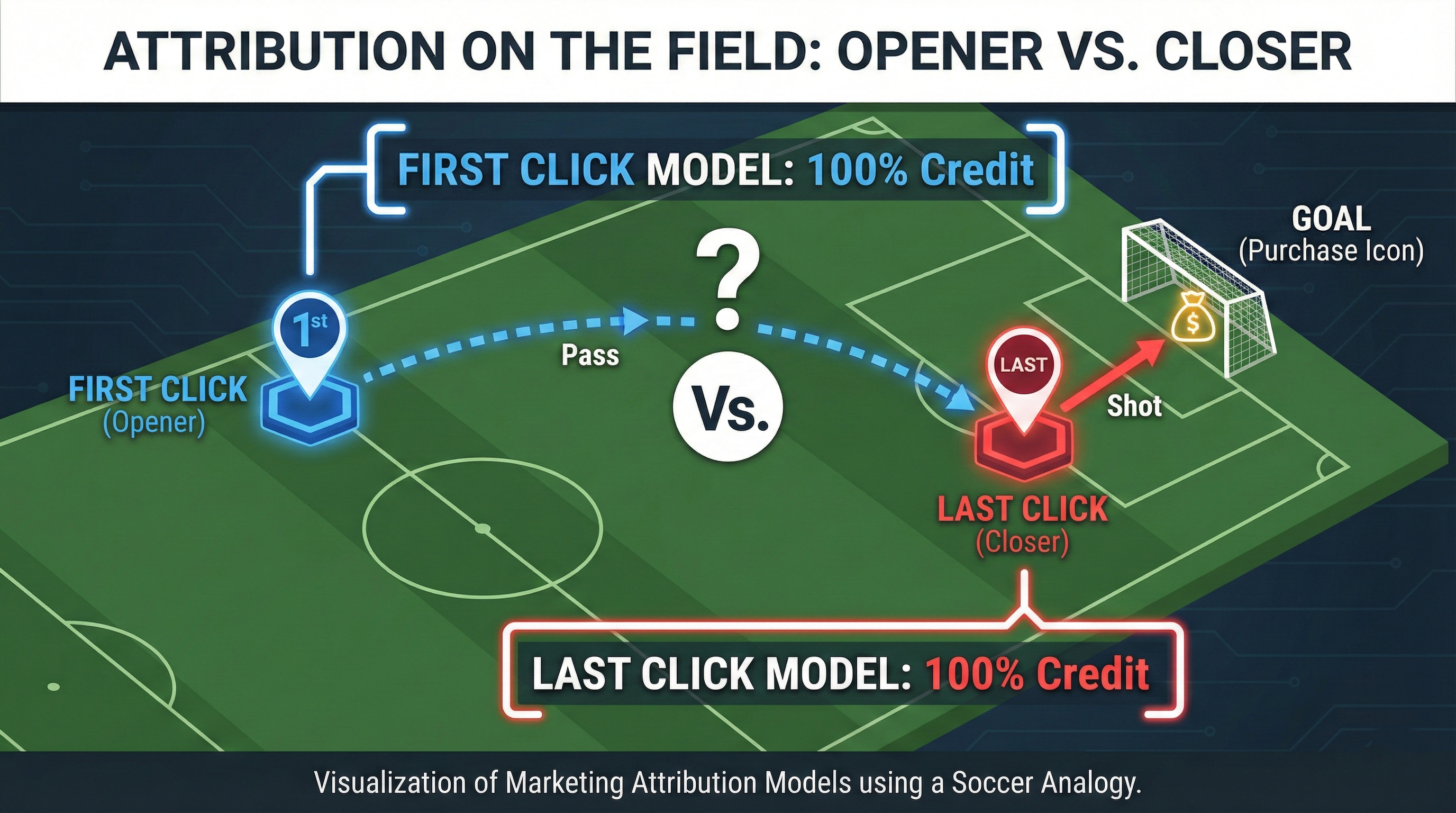
Here is what I tell my clients: Stop thinking about Sales. Start thinking about Soccer.
Marketing is a team sport.
- The First Click (The Brand Manager): This is the midfielder. They pass the ball from the defensive zone. They create the opportunity. Without them, the ball never moves. This is the "Opener."
- The Last Click (The PPC Manager): This is the striker. They receive the pass inside the box and kick it into the net. They get the glory on the scoreboard. This is the "Closer."
The Trap:
Most analytics tools (like Google Analytics 4 or Shopify) default to Last Click. They only look at who kicked the ball last. This makes Retargeting ads and Branded Search look like heroes, while Social Media and Display ads look useless.
If you fire your midfielder (Social) because they aren't scoring goals, your striker (PPC) will never get the ball.
3. The Solution (The Code)
"Let's ask the SQL engine to referee this fight," I said.
To solve this, we don't need complex math. We just need to ask the database two different questions.
Query 1: The "First Click" View (The Opener)
This query finds the channel that started the journey.
/* Model: First Click
   Logic: Give 100% credit to Sequence #1
*/
SELECT
    CHANNEL,
    SUM(ORDER_VALUE) as revenue_attributed
FROM marketing_touches
WHERE TOUCH_SEQUENCE = 1
GROUP BY CHANNEL;
Query 2: The "Last Click" View (The Closer)
This query finds the channel that ended the journey.
/* Model: Last Click
   Logic: Give 100% credit to the MAX Sequence
*/
SELECT
    m.CHANNEL,
    SUM(m.ORDER_VALUE) as revenue_attributed
FROM marketing_touches m
INNER JOIN (
    SELECT ORDER_ID, MAX(TOUCH_SEQUENCE) as last_touch
    FROM marketing_touches
    GROUP BY ORDER_ID
) last_touch_filter ON m.ORDER_ID = last_touch_filter.ORDER_ID
    AND m.TOUCH_SEQUENCE = last_touch_filter.last_touch
GROUP BY m.CHANNEL;
4. The Real Data Scenario
"Let's look at Order #63390122," I said. "This is a perfect example of why you two are fighting."
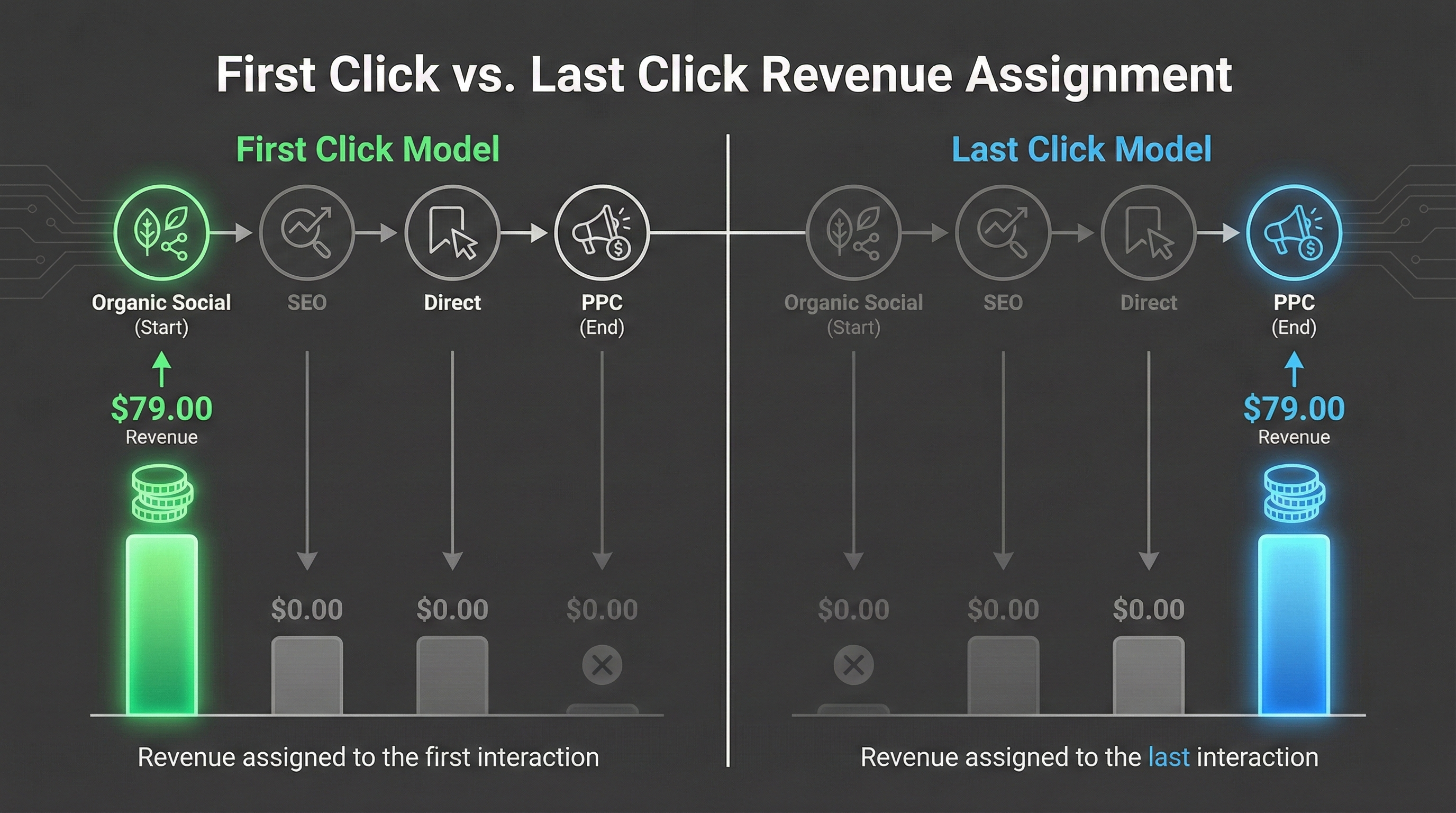
Here is the journey for this specific customer ($79.00 order):
Please ensure the file is named exactly:
blog 3.2.png
The Journey of Order #63390122
Now, let's apply the two models. Watch how the money moves.
The Tug-of-War
5. The Reality Check
The room went silent.
"So," the CEO asked. "Which one is true?"
"Neither," I replied. "They are both lying to you."
If Ujvi Candles adopts First Click, you will pour millions into Instagram. You'll get a lot of traffic, but you might stop retargeting people, and they'll never convert.
If Ujvi Candles adopts Last Click, you will pour millions into Branded Search. You'll harvest all the existing demand, but you'll stop creating new demand (Social), and eventually, your funnel will dry up.
These models are Single Points of Failure. By forcing a choice between the Opener and the Closer, we are completely ignoring the middle of the field (SEO and Direct), which played a crucial role in nurturing the customer.
6. Next Steps
Ujvi's team is starting to sweat. They realize their bonuses depend on a coin flip of which model we choose.
"Isn't there a way," the Brand Manager asked, "to split the credit?"
"Yes," I smiled. "But that gets messy. It's called Linear Attribution, and we'll cover it in Module 04."